


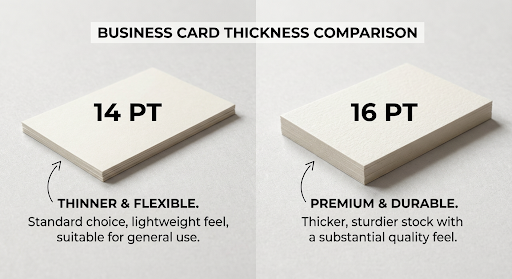
When it comes to 14 pt cardstock vs 16pt, the difference might seem subtle on paper, but it can significantly impact how your business cards are perceived. The 14 pt cardstock measures 0.014 inches (approximately 0.39mm) in thickness, while 16pt cardstock has a thickness of 0.016 inches (approximately 0.406mm). This small difference can actually make a big impression.
In fact, 14 pt cardstock is the most popular option for business cards, offering an excellent balance of strength and flexibility for everyday handling. However, many marketing experts recommend using 16 pt stock because the “difference in feel and marketing value is immeasurable”. If you’re wondering about standard business card thickness, the definition has certainly changed over time, with many professionals now recommending cards that are at least 16pt. Essentially, your choice between these two options can convey different messages about your brand and professionalism.
Whether you’re ordering your first set of business cards or considering an upgrade, understanding these differences will help you make a choice that aligns with your brand image and budget. Let’s explore which cardstock option might be the right fit for your professional needs.
Understanding Cardstock Thickness
What does ‘pt’ mean in cardstock?
The measurement ‘pt’ stands for points in the printing industry, a precise unit that indicates paper thickness (0.001 inches). One point equals exactly 1/1000 of an inch.
14 pt cardstock thickness vs 16pt: Inches and mm
14pt measures 0.014 inches (0.39mm). 16pt measures 0.016 inches (0.406mm).
Normal cardstock ranges between 14pt–18pt (0.014–0.018 inches or 0.36–0.46 mm).
How thick is a business card typically?
Standard business cards are 14pt (0.014 inches or 0.356mm). Premium options can go up to 16pt, 18pt, or even 32pt.
14pt vs 16pt Cardstock: Feature Comparison
Durability
14pt = flexible and strong. 16pt = more rigid and durable.
Feel & Texture
14pt = professional and lightweight. 16pt = premium, heavier feel.
Print Quality
14pt = good color reproduction. 16pt = excellent ink hold and vibrancy.
Weight Comparison
14pt ≈ 100lb text weight 16pt ≈ 130lb cover stock
Use Cases and Practical Applications
Best for bulk printing
14pt is ideal for mass distribution and cost efficiency.
High-stakes meetings
16pt is ideal for premium branding and lasting impressions.
Wallet storage
14pt fits easier in wallets; 16pt stays rigid over time.
100lb Cardstock
A budget option similar to thick paper, good for brochures.
Cost and Customization
Price difference
14pt is typically 2–3% cheaper than 16pt.
Finishing options
Spot UV, embossing, foil stamping, soft touch.
Design flexibility
16pt supports more intricate, high-quality designs.
ROI
16pt provides better impression for important events and presentations.
Comparison Table
| Feature | 14pt Cardstock | 16pt Cardstock |
|---|---|---|
| Thickness (inches) | 0.014 | 0.016 |
| Thickness (mm) | 0.39 | 0.406 |
| Weight | 100lb text weight | 130lb cover stock |
| Durability | Strong & flexible | Rigid & long-lasting |
| Feel/Texture | Professional, not bulky | Premium, substantial feel |
| Print Quality | Good color reproduction | Excellent vibrancy |
| Best Use Cases | Bulk printing, everyday use | Client meetings, premium branding |
| Wallet Storage | More flexible, thinner | More resistant to bending |
| Cost | 2–3% cheaper | Higher cost |
| Market Position | Most common option | Preferred for premium feel |
Conclusion
14pt = best for bulk and everyday use. 16pt = best for premium impression and durability.
FAQs
Q1. What is the main difference?
14pt is flexible; 16pt is thicker and premium.
Q2. Which is better for everyday use?
14pt.
Q3. Which has better print quality?
16pt.
Q4. Is 16pt worth it?
Yes for branding & important meetings.
Q5. What finishing options?
Spot UV, foil, embossing, soft touch.