


Did you know that the thickness of your business card directly influences how potential clients perceive your brand?
When it comes to standard business card thickness, 14pt (approximately 0.356 mm) offers a lightweight option perfect for mass distribution, while 16pt (about 0.406 mm) provides a more robust feel commonly used at professional meetings. However, what was considered “thick” has evolved significantly over time. Previously, 16pt card stock was deemed “thick” and 14pt was average, but today’s premium options extend far beyond these standards. Furthermore, thicker cardstock enhances durability and increases your design possibilities, especially for creating high-quality business cards that make lasting impressions.
Throughout this article, you’ll discover how different thicknesses-from standard 14pt cards to ultra-premium 48pt options (approximately 1.219 mm)-affect everything from tactile experience to brand perception. You’ll also learn practical considerations for selecting the perfect paper stock for your business cards that balances quality, functionality, and budget.
Understanding Business Card Thickness Measurements
In the printing industry, understanding the various thickness measurements for business cards is essential for achieving the right professional look and feel. These measurements follow specific systems that vary across regions but serve the same purpose of indicating how substantial your cards will be.
Points (pt) vs Millimeters (mm) vs Inches
The thickness of business cards is measured through three primary units-each serving different markets. Points (pt) represent the standard measurement in North America, with each point equaling 0.001 inches (one-thousandth of an inch). For instance, when you hear about 14pt or 16pt cardstock, this refers directly to its thickness in thousandths of an inch. Meanwhile, millimeters (mm) offer a metric system measurement more commonly used internationally, providing a universal standard across different regions. Inches, though less frequently referenced directly, form the foundation for point measurements and help bridge between imperial and metric systems.
How to Convert 14pt and 16pt to mm and inches
Converting between these measurement systems is straightforward once you understand the relationships. To convert points to millimeters, remember that 1 inch equals approximately 25.4 mm. Therefore:
- 14pt cardstock = 0.014 inches = approximately 0.356 mm
- 16pt cardstock = 0.016 inches = approximately 0.406 mm
These conversions become particularly important when working with international printers or comparing cardstocks from different manufacturers. Additionally, knowing these equivalents helps you understand exactly how thick your business cards will be regardless of which measurement system is used in product descriptions.
Why Thickness Matters in Print Design
The thickness of your business cards significantly impacts both their functionality and perceived value. Initially, thicker cards demonstrate improved durability-they’re less likely to bend, crease, or tear when handled regularly. Consequently, premium thickness options create a more substantial tactile experience when potential clients receive your card.
Moreover, paper thickness directly affects print quality. Heavier cardstocks generally allow for sharper text reproduction and more vibrant colors. The physical substance of thicker cards also enables advanced design techniques that aren’t possible with standard options, including embossing, letterpress, and specialized coatings.
From a branding perspective, card thickness communicates subtle messages about your business. Thinner paper feels “airy and delicate, communicating elegance,” whereas thicker cards feel “sturdy and unyielding, conveying boldness”. This physical attribute becomes particularly important for cards that need to stand alone in display racks or withstand frequent handling without showing wear.
Standard vs Premium Business Card Thickness
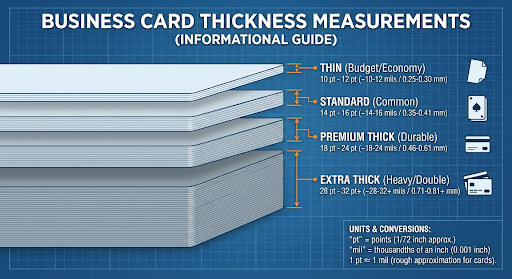
Business card thickness options range from standard to premium, with each option serving different needs and making distinct impressions. The thickness you select directly impacts how recipients perceive your brand and how long they’ll keep your card.
14pt Business Card: Lightweight and Budget-Friendly
A 14pt business card (0.356mm thick) offers a balanced approach for mass distribution. As the most economical option, these cards provide good value without sacrificing quality. Despite being lighter, they maintain flexibility while avoiding flimsy feel. This thickness works perfectly for trade shows or large networking events where quantity matters more than premium quality. Yet, although affordable, these cards may not create the lasting impression needed for high-stakes business meetings.
16pt Business Card: The Industry Standard
The 16pt thickness (approximately 0.406mm) represents the industry standard. This option strikes an ideal balance between affordability and professional quality. In fact, marketing experts recommend 16pt stock because “the difference in feel and marketing value is immeasurable”. These cards resist everyday wear and tear better than 14pt alternatives, making them ideal for professional meetings and conferences. The 16pt option remains the “safe choice” that works with almost all finishing options without feeling too bold.
18pt and 32pt: Premium Feel and Durability
Stepping up to 18pt (approximately 0.46mm) provides a premium tactile experience. These cards offer enhanced durability alongside a noticeably heavier feel. The 32pt cards (about 0.813mm thick) are comparable to credit cards, demonstrating your commitment to quality. These ultra-thick options resist bending and tearing, making them suitable for frequent handling. The 32pt thickness enables specialized design possibilities, including embossing, letterpress, and edge painting.
48pt and Beyond: Ultra-Thick for Luxury Branding
For ultimate luxury, 48pt cards (approximately 1.219mm thick) create unforgettable impressions. At nearly the thickness of a penny, these triple-layered masterpieces exude sophistication. A 48pt card is approximately 1.8mm thick, offering substantial durability alongside premium feel. These ultra-thick options accommodate high-end finishing techniques like foil edges, die cutting, and spot UV treatments. Although considerably more expensive, they demonstrate an unrivaled commitment to quality that recipients won’t forget.
How Thickness Affects Brand Perception and Functionality
The physical thickness of your business card creates immediate sensory feedback that shapes perceptions before a single word is read. This tactile dimension plays a crucial role in how your brand message is received.
Tactile Experience and First Impressions
The moment someone receives your designed business card, they form judgments based on how it feels. A thicker card conveys substance, quality, and professionalism. Cards in the 32pt to 48pt range make a powerful statement that resonates with clients, demonstrating your commitment to quality and attention to detail. Indeed, the weight of your card directly influences how essential your business seems to potential clients.
Durability in Wallets, Racks, and Mailing
Beyond first impressions, practical considerations matter. Thicker cardstock resists bending and tearing during everyday handling. Ultimately, if your card becomes a crumpled mess after being carried in a wallet, your contact information becomes worthless. Cards that are too thick (above 48pt), nonetheless, may not fit into standard business card organizers or wallets, defeating their purpose.
Visual Appeal and Print Finish Compatibility
The thickness of your card affects which printing techniques work best. Thicker stocks (16pt+) accommodate sophisticated techniques like embossing, letterpress, and specialized coatings that enhance visual impact. Selecting appropriate thickness paired with suitable finishes emphasizes professionalism and increases the likelihood of leaving lasting impressions.
Standard Matte vs Glossy Finish Business Card
Matte finishes business cards offer a sophisticated, non-reflective surface that conveys elegance through subtlety. In essence, these cards present clear text regardless of lighting conditions and accept handwritten notes easily. Glossy finishes, conversely, enhance color vibrancy through their reflective properties, making them ideal for designs with vibrant graphics. A 16pt matte-finish card presents sophistication, whereas an 18pt glossy card captures attention through visual vibrancy.
Choosing the Right Cardstock for Your Business Needs
Selecting the perfect cardstock for your business cards requires understanding several key factors that balance both technical and practical needs.
Paper Stock Weight vs Thickness: What to Prioritize
Paper weight (measured in gsm or pounds) differs from thickness (measured in points). Obviously, heavier papers often feel thicker, yet this relationship varies between different types of paper stock. For standardized comparisons, grams per square meter (gsm) provides more consistent measurement across paper types. Still, points (pt) measurements specifically indicate the actual thickness that affects how substantial your card feels in hand.
Design Considerations: Embossing, Letterpress, and Coatings
Certain design techniques specifically require thicker cardstock. Letterpress printing, which creates relief patterns, works best with papers at least 24pt thick, usually 32pt or more. Similarly, embossing or debossing effects need substantial thickness-typically 32pt-to achieve quality results without showing impressions on the reverse side. Even edge treatments like foil or painted edges appear more striking on thicker cards.
Balancing Budget with Brand Goals
Ultimately, thicker cardstock commands higher prices primarily due to increased material usage. Yet, this investment often yields enhanced impressions and durability. For cost-effective quality, 14pt cardstock offers reasonable balance between affordability and professional presentation. Subsequently, 16pt elevates your professional image without extreme cost.
Consulting Print Experts for Custom Solutions
Print professionals possess specialized knowledge about cardstock options beyond what most business owners understand. Accordingly, their expertise becomes invaluable when selecting optimal thickness. Professional printers can recommend specific stocks based on your industry needs, functional requirements, and budget constraints.
Conclusion
Business card thickness plays a far more significant role in your professional image than most realize. Throughout this article, we explored how thickness ranges from standard 14pt cards (0.356mm) to ultra-premium 48pt options (1.219mm), each serving distinct purposes. Standard 14pt cards work best for mass distribution at trade shows, while 16pt has become the industry benchmark balancing quality and cost.
Undoubtedly, premium options like 32pt and 48pt cardstock create memorable first impressions through their substantial feel alone. This tactile experience forms immediate judgments about your brand’s quality commitment before recipients read a single word on your card. Additionally, thicker cards offer practical benefits-they resist bending, maintain appearance longer in wallets, and enable sophisticated printing techniques like embossing and letterpress.
Consider your specific business needs when selecting cardstock thickness. Creative professionals might benefit from premium 32pt options that showcase design capabilities, whereas businesses distributing thousands of cards might find 14pt or 16pt options more economically sensible. Your card thickness should align with your brand positioning and industry expectations.
The physical substance of your business card essentially acts as a silent ambassador for your brand quality. Rather than viewing thicker cards as merely an expense, consider them an investment in lasting brand impressions. After all, your business card often remains the physical reminder of your initial meeting with potential clients or partners long after digital connections have been established.
Choosing the right thickness ultimately requires balancing practical considerations with brand goals. Whether you select standard or premium options, remember that your business card thickness communicates subtle yet powerful messages about your professional identity and attention to detail that resonate long after that first handshake.
FAQs
Q1. What is the standard thickness for business cards?
The industry standard thickness for business cards is 16pt (approximately 0.406 mm). This thickness strikes a balance between professional quality and affordability, making it suitable for most business needs.
Q2. How does business card thickness affect brand perception?
The thickness of a business card significantly impacts brand perception. Thicker cards tend to convey a sense of quality, professionalism, and attention to detail. They create a more substantial tactile experience, which can leave a lasting impression on potential clients.
Q3. What are the benefits of using ultra-thick business cards?
Ultra-thick business cards (32pt and above) offer enhanced durability, resist bending and tearing, and allow for advanced design techniques like embossing and letterpress. They also make a strong statement about your brand’s commitment to quality and can create memorable first impressions.
Q4. Are thicker business cards always better?
While thicker cards often convey premium quality, they’re not always the best choice for every situation. Factors like budget, distribution strategy, and practical considerations (such as fitting into standard card holders) should be taken into account when choosing card thickness.
Q5. How does card thickness affect printing options?
Card thickness impacts available printing techniques. Thicker stocks (16pt and above) are better suited for advanced printing methods like embossing, letterpress, and specialized coatings. They also tend to produce sharper text and more vibrant colors, enhancing the overall visual appeal of the card.


