


There is a specific, quiet heartbreak known only to fleet managers. You invest thousands of dollars in branding your commercial vehicles. The design is bold, the colors are vibrant, and for the first three months, your fleet looks immaculate rolling down the 401.
Then, you walk out to the lot on a cold Tuesday morning in November. You look closely at the deep recesses of the door handle or the body lines on the side panel. You see it: the vinyl has popped out. It is floating a few millimeters off the surface, pulled tight like a drum skin.
This phenomenon is called “Vinyl Bridging,” and it is not just a cosmetic annoyance. It is a catastrophic structural failure of the material system. Once a wrap bridges, it creates a vacuum where condensation collects. In a Toronto winter, that water freezes, expands, and cracks the graphic from the inside out. Within weeks, your professional branding looks like peeling wallpaper.
At Branding Centres, we refuse to let our clients burn capital on wraps that fail the physics test. If your previous wraps have peeled, lifted, or cracked, it wasn’t just “bad luck” or “bad glue.” You were likely the victim of Elastic Memory – the invisible villain of the vehicle wrap industry.
This guide serves as a comprehensive forensic analysis of why wraps fail, the difference between “pizza dough” and “paint,” and the specific physics required to ensure your fleet branding survives the harsh reality of Canadian roads.
The Villain: What is Elastic Memory?
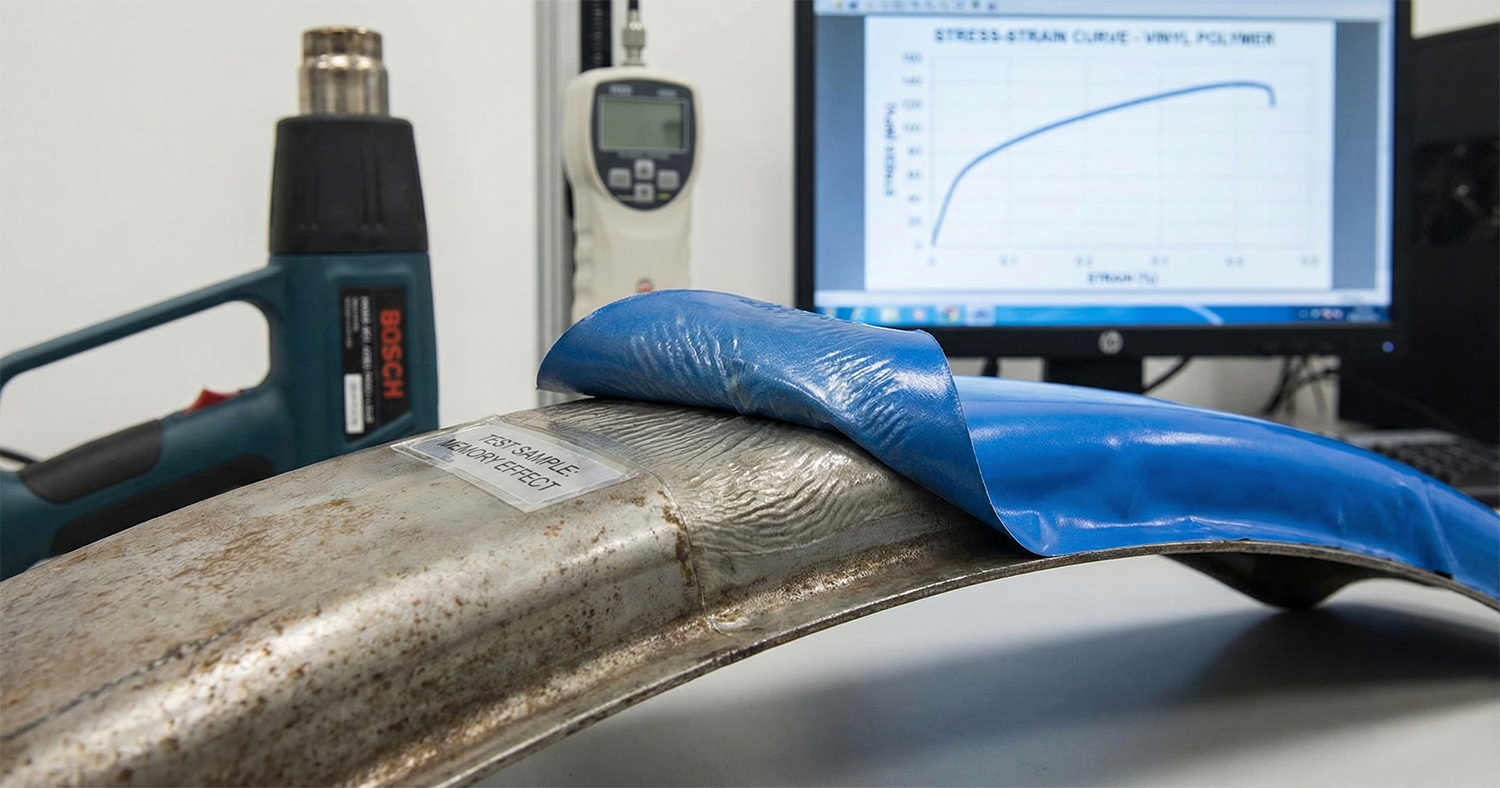
To understand why a wrap lifts, you have to understand the molecular history of the plastic itself. Not all vinyl is created equal. In the industrial printing world, we classify films into two distinct categories based on how they were born: Calendered and Cast.
The difference between these two materials is the difference between a rubber band and a puddle of water. One has memory; the other does not.
The Pizza Dough Problem (Calendered Vinyl)
Calendered vinyl (often sold as “Economy” or “Intermediate” film) is manufactured using a process of brute force. Raw PVC, plasticizers, and pigments are mixed into a semi-solid, dough-like mass. This mass is then fed through massive, heated steel rollers (calenders) that squash, stretch, and flatten the dough into a thin sheet.
Think of this process like rolling out a frozen pizza dough. You can roll it flat, but the moment you stop pushing, the dough tries to shrink back into a ball.
This is Elastic Memory. Because the vinyl was forcibly stretched during manufacturing, it holds internal stress. It “remembers” being a thick lump, and it possesses a thermodynamic desire to return to that shape.
When an installer takes this material and stretches it again to fit into a deep door channel on a Sprinter van, they are adding tension to a material that is already under stress. The vinyl is fighting the installer. It is fighting the adhesive. It is fighting the shape of the vehicle.
The Liquid Solution (Cast Vinyl)
Cast vinyl (the premium standard used by Branding Centres) is created through chemistry, not force. The ingredients are mixed with solvents to create a liquid known as “organosol.” This liquid is poured onto a casting sheet and baked in an oven. The solvents evaporate, and the film solidifies.
Because it starts as a liquid, Cast vinyl has no internal stress. The molecular chains are relaxed and random. It has no “memory” of being anything other than a thin, flexible film. When you stretch Cast vinyl, it doesn’t fight back. It flows.
The Battle of Forces: Shear Strength vs. Retraction Force
According to 3M Science of Adhesion The failure of a vehicle wrap in a recessed channel is a mathematical equation. It is a battle between two opposing physical forces:
1. Shear Strength (The Anchor): This is the ability of the adhesive to hold the vinyl down against the surface of the car. High-quality adhesives (like those on 3M 2080 or Avery Dennison 1105) have excellent shear strength, meaning they resist sliding or lifting.
2. Retraction Force (The Pull): This is the force generated by the vinyl as it tries to shrink back to its original shape due to Elastic Memory.
The “Cold Snap” Failure Mode
This battle is heavily influenced by temperature. When a wrapper installs vinyl in a heated shop (20°C), the material is soft and pliable. The retraction force is low.
However, when that vehicle drives out into a Canadian winter (-10°C), the physics change. The vinyl stiffens. The “memory” activates aggressively, causing the vinyl to contract. Simultaneously, the cold causes the adhesive to become brittle, reducing its grip.
If you used Calendered vinyl, the Retraction Force suddenly spikes, exceeding the Shear Strength of the glue. The bond breaks. The vinyl snaps back, pulling out of the recess and creating a bridge.
The Solution: The 90°C Rule (Annealing)
So, if we use Cast vinyl, are we safe? Not entirely. Even Cast vinyl has limits. To ensure a permanent bond in the deepest channels – like the complex curves of a Mercedes Sprinter or the body lines of a Ford Transit – we must perform a procedure known as Post-Heating or Annealing.
This is the step that separates “sticker guys” from professional installers.
Erasing Molecular Memory
When we stretch Cast vinyl into a deep groove, we do introduce a small amount of temporary tension. If we leave it like that, it might lift over time.
To fix this, our installers use digital heat guns to bring the vinyl surface temperature to a specific critical threshold: 90°C (194°F) to 100°C (212°F).
Why 90°C? At this temperature, the polyvinyl chloride (PVC) molecules gain enough kinetic energy to break their temporary bonds and reorganize. They “forget” their original shape and adopt the new shape (the shape of the deep channel) as their permanent, natural state.
We are essentially “re-casting” the vinyl on your vehicle. Once it cools down from 90°C, the vinyl is no longer “stretched” into the channel; it is the shape of the channel. The retraction force drops to near zero.
The Branding Centres Protocol
At Branding Centres, we enforce a strict installation protocol to prevent memory-effect failure:
1. Cast Only: We exclusively use premium Cast films (3M 2080 Series, Avery Dennison SW900) for any vehicle with curves or recesses.
2. The 24-Hour Cure: We recommend keeping the vehicle in our temperature-controlled facility for 24 hours after installation. This allows the adhesive to build its maximum bond strength before being exposed to the elements.
3. Post-Heat Verification: Our installers use infrared thermometers to verify that every inch of recessed vinyl has hit the annealing temperature of 90°C. We don’t guess; we measure.
The “Ghosting” Warning: The Hidden Cost of Failure
Some business owners see a little bit of lifting in the door handles and think, “It’s not that bad. It’s just a little bubble. I can live with it.”
The problem is that a “bridge” is not a sealed vacuum. It is a trap.
The Dirt Line
As the vinyl lifts, the adhesive on the back is exposed. Road grit, salt, and diesel exhaust dust are sucked into the air gap. This debris sticks to the exposed glue, creating a dark, jagged black line outlining your door handles and recesses. On a white or light-colored wrap, this looks dirty, neglected, and unprofessional. It signals to your customers that you don’t take care of your equipment.
The “Ghosting” on Removal
The damage isn’t just to your image; it’s to your asset. When water gets trapped behind bridged vinyl, it creates a micro-climate of moisture against your clear coat. Over 3 to 5 years, this trapped moisture, combined with UV exposure variations, can cause Ghosting.
When you finally peel the wrap off to sell the truck, you will find that the paint under the “bridged” areas has aged differently than the paint that was properly adhered. You may see a permanent outline of the failure etched into the clear coat.
Furthermore, cheap calendered vinyl often uses aggressive solvent-based adhesives to compensate for its shrinkage. These adhesives harden over time. When you try to remove a cheap wrap after 4 years, the vinyl chips off in tiny flakes, and the glue stays behind. Removing this residue often requires harsh chemicals that can burn through your clear coat, destroying the resale value of the vehicle.
Conclusion: Stop Fighting Physics
In the world of fleet graphics, you get exactly what you pay for. A “bargain” wrap that costs $2,500 but uses Calendered vinyl is not a savings; it is a liability.
• The Economy Wrap: Saves you $500 today. Fails in 8-12 months. Costs $500+ to remove the baked-on adhesive. Requires a $3,000 re-wrap.
◦ Total Cost of Ownership (3 Years): $6,000+
• The Branding Centres Premium Wrap: Uses 3M/Avery Cast. Annealed to 90°C. Lasts 5-7 years. Removes cleanly. protects your resale value.
◦ Total Cost of Ownership (3 Years): $3,000
A vehicle wrap should be an asset that generates millions of impressions, builds trust, and protects your fleet. If you use the wrong material for deep channels, you are fighting a battle against physics that you will eventually lose.
At Branding Centres, located in Etobicoke and serving the entire GTA, we engineer our fleet graphics to survive the real world. We use premium Cast materials that conform to your vehicle, ensuring your brand looks as professional on day 1,000 as it did on day 1.
Is your current fleet showing signs of bridging? Don’t wait for the vinyl to crack. Contact Branding Centres today at info@brandingcentres.com or +1-(416) 288-8661 for a fleet audit and a long-term solution.
Frequently Asked Questions (FAQs)
1. Why is the vinyl popping out of my door handle cups?
This is the classic symptom of “Vinyl Bridging.” If your installer used Calendered (economy) vinyl, the material has “elastic memory.” It remembers being flat and is constantly fighting the adhesive to shrink back to its original shape. Eventually, the tension wins, the glue fails, and the vinyl lifts, creating an air gap.
2. Can I simply press the vinyl back down if it lifts?
Unfortunately, no. Once the vinyl has “bridged” or lifted, the adhesive on the back has likely dried out or become contaminated with dust. Pressing it back down is a temporary fix that will likely pop back up within hours. Furthermore, the vinyl has now stiffened in that lifted position. The only permanent fix is usually to replace the affected panel with Cast Vinyl.
3. Is Calendered vinyl ever a good choice?
Yes, but only for specific applications. Calendered vinyl is thicker and more affordable, making it suitable for perfectly flat surfaces like box trucks or simple decals on flat doors. However, for any vehicle with compound curves, deep recesses (like Sprinter vans), or rivets, Cast vinyl is the mandatory choice to prevent failure.
4. What is “Post-Heating” and why does it matter?
Post-heating (or annealing) is a critical installation step. After applying the wrap, we use heat guns to bring the vinyl temperature up to 90°C (194°F) in the deep channels. This process breaks the memory of the PVC, effectively “resetting” it to the new shape of the channel. This ensures the vinyl stays down permanently and does not try to shrink back.
5. Will a lifting wrap damage my paint?
It can. When vinyl bridges, it creates a pocket where water and road salts can accumulate. In the winter, this water freezes and expands, which can crack the vinyl. Over time, the trapped moisture and debris can cause “ghosting” or etching into the vehicle’s clear coat, leaving a permanent outline of the failure even after the wrap is removed.


