



Did you know that 56% of consumers find print marketing to be the most trustworthy type of marketing? In a world drowning in digital noise, print marketing materials still command remarkable attention and response.
In fact, direct mail campaigns achieve a 9% customer response rate compared to just 1% from digital marketing channels . Despite the digital revolution, tangible marketing pieces offer a refreshing break from screens and devices . Furthermore, print materials have a longer lifespan than digital advertisements, as they can be kept, shared, and revisited by recipients .
The average person is bombarded with approximately 10,000 marketing messages every day . That’s why creating print materials that stand out is more crucial than ever. When done right, print marketing helps your business cut through the clutter and boost visibility in a crowded marketplace .
In this comprehensive guide, we’ll walk you through the step-by-step process of creating print marketing materials that actually convert. From understanding different types of print marketing materials to mastering design guidelines that drive action, we’ve got you covered. Let’s transform your print marketing from forgettable to phenomenal!
Understand the Role of Print Marketing Today
The landscape of marketing continues to evolve, yet physical promotional materials remain a cornerstone of effective advertising strategies. Understanding how print fits into today’s marketing mix is essential for businesses seeking to maximize their reach and impact.
What is print marketing?
Print marketing refers to using physical printed materials such as letters, postcards, brochures, flyers, and magazines for advertising purposes. Unlike digital formats that exist only on screens, print marketing creates tangible touchpoints between your brand and potential customers. It serves as both a brand awareness tool and a powerful driver for purchase decisions.
Print isn’t meant to stand alone in your marketing strategy. Rather, it functions as a critical component of an omnichannel approach. As eCommerce Marketer Amy Auble notes, “The secret to successful marketing is using all your channels well”. This integrated approach allows consumers to connect with your brand through multiple channels, creating a cohesive experience that reinforces your message.
Why print still matters in a digital world
In an era of digital saturation, print marketing offers distinct advantages that digital simply cannot match:
Enhanced Trust and Credibility: Approximately 82% of consumers trust print ads most when making purchasing decisions. Similarly, direct mail is perceived as more trustworthy than social media ads by nearly half of US adults. This built-in credibility gives print a significant edge in establishing authentic connections.
Superior Memorability: A study by Canada Post found that 75% of participants could recall brand names from print mail advertising, while only 44% remembered brands from digital ads. Our brains process physical materials differently-the tactile experience creates stronger memory imprints.
Longer Engagement Time: Print materials typically receive more focused attention. “We have a better attention span for tactile mail. Even if you take the mail and throw it in the trash, you still spend three seconds looking at the brand message instead of the moment it takes to delete an email,” explains Katie Young, Director of Sales.
Reaches Valuable Demographics: Print effectively targets audiences with significant purchasing power. Baby Boomers, who hold 53.4% of the United States’ wealth, are particularly receptive to print advertising. Additionally, print helps you reach those experiencing digital fatigue or with limited digital access.
Psychological Benefits: Remarkably, 41% of Americans look forward to checking their mailbox each day. This positive emotional association creates an optimal mindset for receiving your marketing message.
Print marketing materials examples
Today’s most effective print marketing materials include:
- Business Cards – Still essential for networking and creating first impressions
- Brochures & Catalogs – Allow for detailed information sharing in an appealing format
- Direct Mail – Including postcards and letters that achieve higher response rates than email
- Flyers & Posters – Cost-effective options for local promotion and high visibility
- Promotional Products – Branded items that keep your company visible in everyday life
- Packaging – Product packing containers that both protect items and promote your brand
- Newsletters – Physical publications that receive more attention than email newsletters
Modern print marketing has evolved to incorporate innovative elements like textured materials, QR codes linking to digital experiences, and personalization-making today’s print materials more interactive and measurable than ever.
Ready to elevate your print marketing strategy? Visit our website today for custom templates and design services that will help your print materials stand out and drive real conversions.
Step 1: Define Your Goals and Audience
Before designing your print marketing materials, laying a strategic foundation is essential for success. Creating materials without clear direction is like navigating without a map-you might eventually reach a destination, but it probably won’t be your intended one.
Clarify your campaign objectives
First and foremost, establish specific objectives that align with your overall business goals. Vague goals like “increasing sales” provide little guidance. Subsequently, use the SMART framework-Specific, Measurable, Achievable, Relevant, and Time-bound-to create focused objectives.
For example, rather than simply aiming to “increase sales,” define your goal as “increase shampoo sales by 15% over the next six weeks”. Alternatively, you might aim to “increase per-order revenues by 5%”.
Your campaign objectives might include:
- Revenue growth through aggressive prospecting
- Margin expansion via premium products
- Increasing customer volume
- Deepening customer loyalty
These clearly defined objectives become guiding principles that inform every aspect of your campaign, from design and messaging to distribution channels. Consequently, when everyone understands the campaign’s objectives, it fosters collaboration and ensures resources are allocated appropriately.
Identify your target audience
Your target audience is the specific group of people most likely to buy or use your product or service. Identifying this group is crucial since it helps create more effective marketing, reduces wasted ad spend, improves engagement, and increases conversions.
A common mistake businesses make is thinking everyone is their audience. Although this sounds inclusive, it’s too vague to be useful. For instance, saying “Our product is for anyone who wants to get fit!” lacks the specificity needed for effective targeting.
To define your target audience effectively, examine your existing customer base. Look at demographics such as age, gender, location, income level, and education. Likewise, consider psychographic elements like lifestyle, values, interests, and pain points.
Additionally, research competitors to understand who they’re targeting. This competitive analysis can reveal gaps in the market that your competitors aren’t filling. Furthermore, utilize surveys, interviews, and analytics tools to gather direct feedback.
Match message to audience needs
Once you understand your audience, tailor your messaging to resonate with their needs, preferences, and pain points. As a result, your print marketing materials become highly relevant and compelling, increasing the likelihood of engagement and conversion.
Creating buyer personas-profiles of imaginary people representing your ideal customers-can help customize your message effectively. These detailed profiles should include goals, challenges, media consumption habits, and behaviors.
Beyond demographics, understanding purchasing behavior is perhaps most important. How do they research products? Where do they seek information? These details should inform how you market to them.
Remember, different segments of your audience may require different approaches. For example, if you sell hair products, your audience might include individual users, gift-buyers, small business resellers, and salons-each needing distinct messaging.
Ready to create print marketing materials that truly connect with your audience? Visit our website today for customized templates that align perfectly with your campaign objectives and target audience needs.
Step 2: Choose the Right Print Format
Once you’ve identified your goals and audience, the next crucial step is choosing the right print format for your message. The medium you select fundamentally affects how recipients perceive and interact with your content.
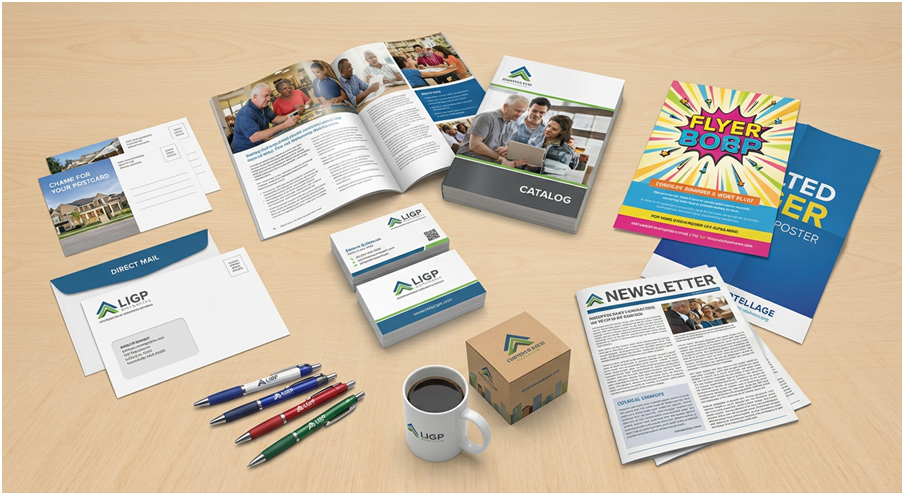
Types of print marketing materials
The variety of print marketing options available today is extensive, each serving different purposes:
Business Cards: Still essential for networking and first impressions, these personalized business cards are small yet mighty marketing tools create lasting impressions even in brief encounters.
Brochures: Available in bi-fold, tri-fold, or custom formats, brochures provide space for detailed information and storytelling. They’re particularly effective for service businesses, real estate, and multi-offer promotions.
Flyers: Single sheets designed for quick distribution and mass awareness. Notably, flyers excel at promoting events, seasonal specials, and community announcements.
Postcards: Thick cardstock mailers that stand out in mailboxes without requiring envelopes. These durable pieces are ideal for direct mail campaigns and coupon offers.
Catalogs: Perfect for showcasing multiple products in an engaging format. Research shows 60% of catalog recipients visit the company’s website after viewing.
Other formats include direct mail pieces, promotional products, packaging inserts, door hangers, billboards, and letterhead.
When to use brochures, flyers, or postcards
Choosing between these common formats depends on your specific objectives:
Choose brochures when:
- You need space for detailed explanations
- Your product or service requires educational content
- Building credibility is paramount
- You’re promoting multiple services or higher-ticket offers
Opt for flyers when:
- Speed and volume distribution are priorities
- You’re announcing time-sensitive events or sales
- Budget constraints exist (lowest unit cost at volume)
- You need something easily handed out at busy locations
Select postcards when:
- Direct mail is your distribution method
- You want high visibility in mailboxes
- Your message is concise with one clear call to action
- You need something durable that doesn’t require an envelope
Custom print marketing materials for niche campaigns
For specialized marketing efforts, consider:
Dimensional mailers that have among the highest response rates of all direct mail pieces
Personalized brochures which reportedly achieve some of the highest conversion rates among print materials.
Product-specific formats aligned with your business type: catalogs for product-driven companies or detailed brochures for service-driven businesses.
Ultimately, the format you choose should match both your campaign objectives and budget considerations. Additionally, paper quality, finish, and unique design elements can elevate standard formats into attention-grabbing custom pieces.
Ready to create print marketing materials that truly convert? Visit our website today for expertly designed templates that will help your business stand out and drive real results.
Step 3: Design Materials That Convert
Design is the make-or-break element for marketers. Studies reveal that users form an opinion about your page’s visual appeal in just 50 milliseconds, and 48% judge your business’s credibility by looking at your design. Creating print marketing materials that convert isn’t just about making them pretty-it’s about strategic design decisions that drive action.
Print marketing materials design guidelines
Conversion-Centered Design (CCD) provides a framework for building high-converting marketing campaigns. This approach encompasses persuasive design techniques and psychological triggers that encourage visitors to take action. The first principle is creating focus-the more options you give readers, the more likely they’ll be to get confused. Analysis of over 20,000 landing pages showed that more links on a page correlate with lower conversion rates. Therefore, choose ONE clear goal for your print material and design around it.
Using color, layout, and typography effectively
Color significantly influences perception and response. Reserve your boldest, most eye-catching color exclusively for your call to action to naturally draw attention. For typography, choose fonts that align with your message-serif fonts may evoke tradition while sans-serif fonts speak to contemporary simplicity. Furthermore, establish a clear hierarchy through variations in font size, weight, and style, ensuring critical details stand out.
White space isn’t empty space-it helps emphasize key elements and makes content easier to digest. Additionally, structure your information in Z-Pattern or F-Pattern layouts as they tend to help increase conversion rates.
Crafting a strong call to action
A compelling CTA turns interest into measurable outcomes. It should be visible, specific, and motivating. Your CTA button should be approximately twice the size of your body copy to draw attention, ideally being the second thing visitors notice after reading the headline. Use direct language that inspires confidence and urgency, emphasizing immediate benefits such as saving, learning, or discovering.
Ensuring brand consistency
Consistency between your print materials and other assets helps readers feel they’ve “landed” in the right spot. Ideally, use the same fonts, colors, and styles across all materials. Stick to two fonts (one for headers, one for body) and no more than three main colors. This cohesive visual identity strengthens your brand’s presence and reinforces brand recognition.
Ready to create print materials that actually convert? Visit our website today for expertly designed templates that incorporate these proven conversion principles.
Step 4: Print, Distribute, and Track
Executing your print marketing campaign requires careful attention to production and measurement details. From paper selection to tracking campaign performance, every decision impacts your conversion rates.
Selecting paper type and finish
Paper selection impacts both perception and performance of your print materials. Coated papers work best for designs with sharp text and bold colors, whereas uncoated papers create a more organic look and allow for easy writing. Consider paper thickness carefully-thicker materials feel more premium yet cost more and may not work for all applications. For brochures or postcards that need durability, opt for heavier stock (200+ GSM).
Working with professional printers
Begin by researching printers specializing in your specific project type. During initial consultation, discuss timeframe, capabilities, pricing, and file preparation requirements. Providing correctly prepared artwork files is crucial-each printer has specific guidelines for file submission. Moreover, always request a physical proof before approving full production runs to ensure colors, sizes and other elements appear as intended.
Distribution strategies that work
Direct mail remains incredibly effective-nearly 90% gets opened compared to only 20% of marketing emails. At trade shows, differentiate your materials from competitors to grab attention. Furthermore, consider including print materials in order shipments, placing them at reception desks, and distributing at local events to maximize exposure.
Using QR codes and URLs to track results
QR codes connect offline materials to online experiences, making print campaigns measurable. When someone scans your QR code, they’re redirected to your website where analytics tools track their behavior. To implement effectively, decorate your URL with UTM parameters (source, medium, campaign), then shorten it before generating the QR code. This approach transforms traditional print materials into powerful conversion tools with trackable metrics.
Ready to create print materials that deliver measurable results? Visit our website today for custom templates that incorporate QR tracking technology for maximum ROI.
Conclusion
Print marketing remains a powerful tool in our increasingly digital world. Throughout this guide, we’ve explored the essential steps to create print materials that actually convert. You now understand why print still matters, how to define clear goals, identify target audiences, choose appropriate formats, and design materials that drive action.
Remember that effective print marketing starts with strategy, not design. Your materials must align perfectly with campaign objectives and speak directly to your audience’s needs. Similarly, your design choices should guide readers toward a single, clear action rather than overwhelm them with options.
Production quality matters significantly. The right paper, professional printing, and strategic distribution all work together to maximize your campaign’s impact. Additionally, modern tracking methods like QR codes transform traditional print into measurable marketing channels with trackable ROI.
The statistics speak for themselves-56% of consumers find print marketing most trustworthy, and direct mail achieves response rates nine times higher than digital channels. These numbers prove that print deserves a prominent place in your marketing mix.
Ready to transform your marketing with print materials that actually convert? Visit our website today for professionally designed templates, custom printing services, and expert guidance that will help your business stand out in the physical world. Take action now and watch your conversion rates soar with print marketing that truly works!


