


In the competitive business landscape of Toronto, Etobicoke, and the entire GTA, the physical quality of your marketing materials speaks volumes about your brand before a customer even reads a single word. Whether you are producing an annual report, a product catalog, or a promotional magazine, the physical construction of the piece is just as critical as the graphic design. One of the most common technical decisions you will face during the printing process is choosing the right binding method. The two heavyweights in this arena are Perfect Binding and Saddle Stitching.
While they both serve the function of holding pages together, they do so in vastly different ways that impact cost, durability, aesthetics, and user experience. Making the wrong choice can lead to a brochure that will not close properly or a catalog that falls apart after a week. Making the right choice, however, elevates your brand authority and ensures your message endures.
At Branding Centres, we believe in a holistic approach to your corporate identity. From the business cards in your pocket to the fleet graphics on your trucks, consistency is key. Your print materials will be visually strategized and Designed by Branding Centres to ensure maximum impact. And we ensure your printed assets are bound with precision to withstand the rigors of the real world.
This comprehensive guide will dissect the differences between perfect binding and saddle stitching to help you determine which method is superior for your specific project.
Understanding the Basics of Booklet Binding
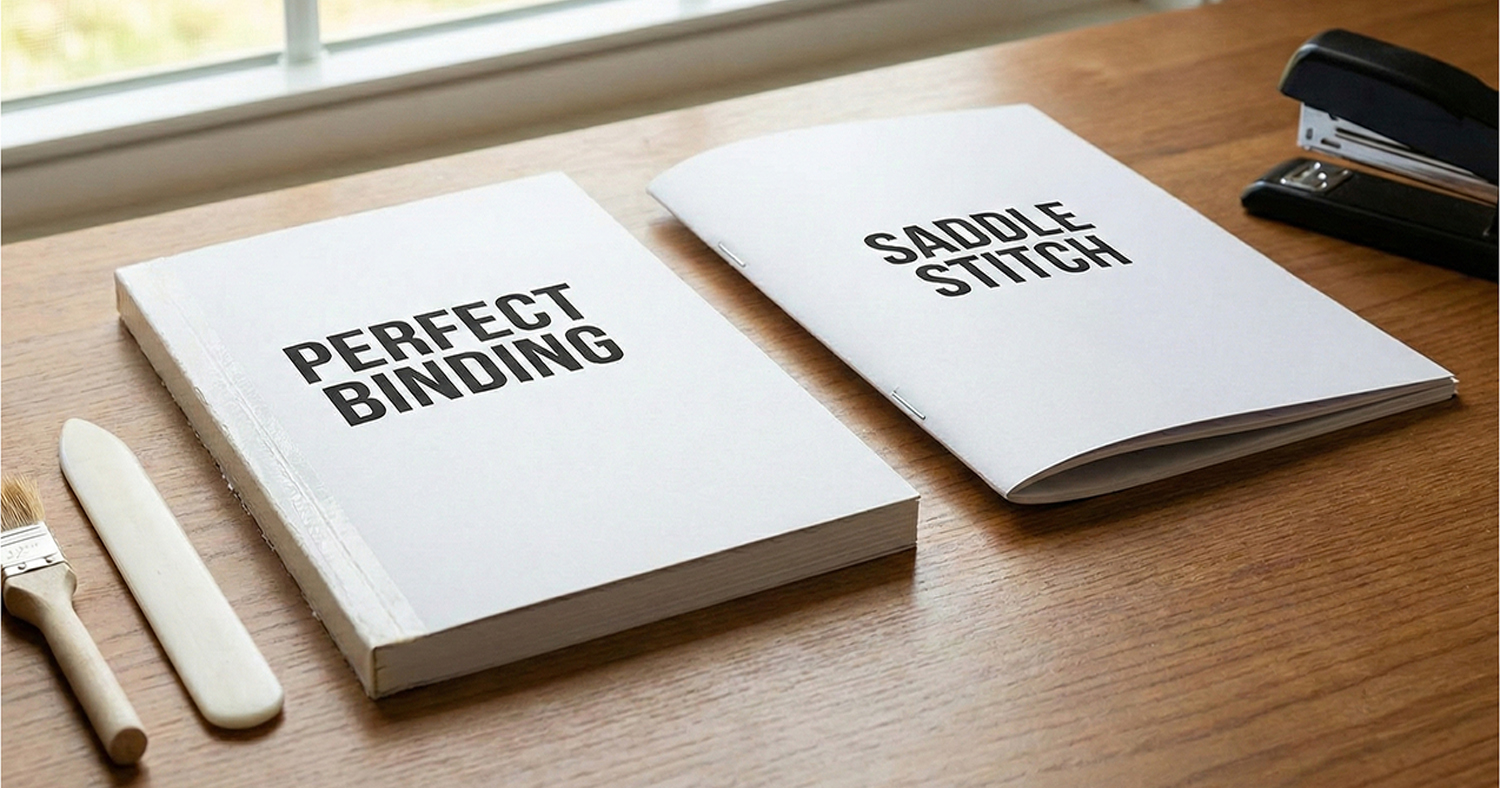
Before declaring a winner in the battle of Perfect Binding vs Saddle Stitch, it is essential to understand what these terms actually mean in the printing industry. Binding is the final stage of the manufacturing process, often referred to as “finishing.” It is the engineering that turns loose sheets of paper into a coherent, navigable publication.
In the Toronto printing market, the choice of binding is often dictated by three primary factors:
1. Page Count: The total number of pages in your document.
2. Budget: The financial resources allocated to production.
3. End Use: How the reader will interact with the document.
Let’s explore the mechanics of each option.
What is Saddle Stitch Binding?
Saddle stitching is the most ubiquitous binding method for booklets, magazines, and newsletters in Ontario. Despite the name “stitch,” there is usually no thread involved in modern commercial applications.
The Mechanics of Saddle Stitching
The process involves taking large sheets of paper, folding them in half, and nesting them inside one another. The folded crease becomes the spine of the booklet. Metal wire staples are then driven through the fold from the outside to the center, clinching the pages together. The term “saddle” comes from the apparatus the paper rides on during the stapling process.
Ideal Use Cases for Saddle Stitch
This method is the industry standard for documents with lower page counts. It is commonly used for:
• Event Programs: For conferences or festivals in Mississauga.
• Newsletters: Monthly updates sent to clients.
• Direct Mailers: Lightweight brochures designed for Canada Post distribution.
• Product Manuals: Thin instructional booklets included with consumer goods.
• Comic Books: The classic format for serialized graphic storytelling.
The Page Count Constraint
Saddle stitching relies on the ability of a staple to penetrate the paper stack. Therefore, it is generally limited to documents with a page count between 8 and 64 pages. Once you exceed 64 pages (depending on paper thickness), the booklet tends to “balloon” open and will not lie flat, creating an unprofessional appearance.
What is Perfect Binding?
Perfect binding is the method used for softcover books, premium magazines, and substantial corporate catalogs. It offers a sophisticated, retail-ready appearance that commands respect.
The Mechanics of Perfect Binding
In this process, the interior pages and the cover are glued together at the spine using a strong thermal adhesive. The edges of the interior pages are often ground down or roughened to allow the glue to penetrate the paper fibers, creating a strong bond. The cover is then wrapped around the block of pages, creating a square, flat spine.
Ideal Use Cases for Perfect Binding
Perfect binding is the go to choice for publications that need to convey high value or contain a large amount of information. Common applications in the GTA include:
• Annual Reports: Corporate filings for stakeholders.
• Fashion and Lifestyle Magazines: Publications that sit on newsstands.
• Thick Catalogs: Comprehensive product listings for industrial suppliers.
• Paperback Books: Novels and non fiction works.
• Employee Handbooks: Substantial internal documents.
The Page Count Requirement
Perfect binding requires a minimum spine width for the glue to hold effectively. Generally, a document needs to be at least 40 pages (or roughly 0.125 inches thick) to be a candidate for perfect binding. If the spine is too thin, the glue surface area is insufficient, and pages may fall out. Conversely, this method can accommodate hundreds of pages, making it the only viable option for thick documents.
Detailed Comparison: Perfect Binding vs Saddle Stitch
To determine which is better for your business in Vaughan or Brampton, we must compare them across several critical performance metrics.
1. Cost Efficiency
For many small businesses, budget is the deciding factor.
• Saddle Stitch: This is almost always the more economical option. The setup times are faster, and the materials (wire staples) are negligible in cost compared to thermal glues. For short run printing or high volume direct mail campaigns where unit cost is paramount, saddle stitch wins.
• Perfect Binding: This process is more labor intensive and requires more expensive materials. While the cost per unit decreases significantly as print volumes increase, perfect binding generally commands a premium price.
2. Aesthetic Appeal and Branding
How your document looks on a shelf matters.
• Saddle Stitch: The spine is a folded edge. It cannot be printed on. When a saddle stitched booklet is placed on a bookshelf, it effectively disappears. It looks like a magazine or a pamphlet.
• Perfect Binding: The square spine is a printable surface. You can print your document title, volume number, and brand logo directly on the spine. This allows for identification when the book is shelved, providing a significant branding advantage. It looks like a “real book” and carries a higher perceived value.
3. Durability and Longevity
• Saddle Stitch: Staples are durable, but the paper around the staple can tear over time with heavy use. However, for disposable media like newsletters, this is rarely an issue.
• Perfect Binding: Modern adhesives, particularly PUR (Polyurethane Reactive) glue, are incredibly strong and resistant to temperature extremes. A perfect bound book generally has a longer lifespan and withstands repeated handling better than a stapled booklet.
4. Functionality (The “Lay Flat” Factor)
• Saddle Stitch: Because it is just folded paper, a saddle stitched booklet lies almost completely flat when opened. This is crucial for designs that span across two pages (crossovers), such as maps, large photos, or architectural drawings.
• Perfect Binding: A standard perfect bound book has a rigid spine. It will not lay flat on its own and often tries to snap shut. Content printed too close to the spine (the gutter) can get lost in the fold. Designers must account for this by leaving wider margins on the inside edges of the pages.
Comparison Table: At a Glance
| Feature | Saddle Stitch Binding | Perfect Binding |
| Primary Mechanism | Metal Staples (Wire) | Thermal Adhesive (Glue) |
| Ideal Page Count | 8 to 64 Pages | 40 to 300+ Pages |
| Cost Profile | Low (Budget Friendly) | Moderate to High (Premium) |
| Spine Appearance | Folded Edge (Not Printable) | Square Spine (Printable) |
| Shelf Presence | Minimal | High (Visible Title/Logo) |
| Lay-Flat Ability | Excellent (Opens 180°) | Poor (Rigid Spine) |
| Production Speed | Fast | Slower (Requires Curing) |
| Perceived Value | Standard / Casual | High / Professional |
Design Considerations for Your Print Project
When you work with Branding Centres, your project is Designed by Branding Centres with the final manufacturing method in mind. The design rules for these two bindings differ significantly.
Designing for Saddle Stitch: The “Creep” Factor
Because saddle stitching involves nesting sheets inside one another, the inner sheets stick out further than the outer sheets before they are trimmed. This phenomenon is called “creep.” If your designer does not account for creep, the page numbers or text near the outer edge of the center pages might get cut off during the final trim. We calculate the exact paper thickness to adjust the layout, ensuring every page is perfectly centered.
Designing for Perfect Binding: The “Gutter” Safety
With perfect binding, the glue eats up about 0.25 to 0.375 inches of the inside edge of the page. If you place text or a face in a photograph across this “gutter,” it will vanish into the spine. We ensure that safe margins are applied to the inside edges of all pages so that your content remains legible and visually balanced. We also calculate the precise width of the spine based on the paper stock to create a seamless wraparound cover design.
Paper Selection: The Foundation of Binding
The choice of paper stock interacts directly with your binding choice. In Toronto, where environmental humidity varies, paper choice is critical for product longevity.
Paper Weight and Stiffness
For saddle stitching, the paper must be flexible enough to fold without cracking. If you choose a very thick cover stock (e.g., 14pt cardstock) for a saddle stitched booklet, we must “score” (pre-crease) the paper to prevent the fibers from breaking and creating an ugly, jagged edge at the fold.
For perfect binding, the interior pages (text stock) are usually lighter (e.g., 80lb or 100lb text), while the cover is heavier (10pt or 12pt cover). This contrast provides structural integrity. If the interior pages are too stiff, the glue may struggle to hold them against the leverage of the page turning.
Coatings and Finishes
• Gloss: Excellent for photography and vibrant colors.
• Matte/Silk: Sophisticated and easier to read for text heavy documents.
• Uncoated: Provides a raw, organic texture popular with eco conscious brands.
Note that some coatings can interfere with adhesives. If you are perfect binding, the spine area must be kept free of varnish or heavy ink coverage to ensure the glue bonds to the paper fibers, not the coating.
Distribution Logistics in the GTA
Your choice of binding also impacts your distribution strategy and costs.
Direct Mail Considerations
If you plan to utilize Canada Post for a direct mail campaign, saddle stitching is often advantageous. It is lighter and less rigid, making it easier to process through automated sorting machines. Perfect bound books are heavier and thicker, which can push you into a higher postage bracket.
Storage and Warehousing
Perfect bound books stack neatly and squarely, making them easier to warehouse and inventory. Saddle stitched booklets, due to the slight bulge at the spine, do not stack as flatly. If you are printing 10,000 copies to store in a Mississauga warehouse, perfect binding offers better space utilization.
When to Choose Which? The Verdict
There is no single “better” option; there is only the option that is better for your specific goals.
Choose Saddle Stitching If:
1. You have a low page count: If you have fewer than 40 pages, saddle stitch is the practical choice.
2. You are on a tight budget: It is the most cost effective method for mass distribution.
3. You need the book to lie flat: Essential for cookbooks, coloring books, or instructional manuals where the user needs their hands free.
4. You need a fast turnaround: The production process is quicker, perfect for meeting tight event deadlines.
Choose Perfect Binding If:
1. You have a high page count: For documents over 60 pages, perfect binding is structurally necessary.
2. You want a premium image: If you are selling luxury condos in Etobicoke or high end consulting services, the “thud” of a perfect bound book conveys substance and quality.
3. You need shelf visibility: The printable spine allows your brand to be seen even when the book is stored away.
4. You want longevity: For documents intended to be kept for years (like a reference catalog), the durability of thermal glue is superior.
Conclusion
Choosing between perfect binding and saddle stitching is a decision that balances form, function, and finance. Saddle stitching offers economy and utility for shorter documents, while perfect binding offers durability and prestige for substantial publications.
Don’t leave your printing to chance. Partner with a team that understands the technical nuances of production and the strategic importance of design. Your project will be conceptualized and Designed by Branding Centres to meet the highest standards of the industry.
Ready to start your next print project? Contact Branding Centres today to discuss whether perfect binding or saddle stitching is the right fit for your business goals.
Frequently Asked Questions (FAQs)
1. What is the minimum page count for perfect binding?
Generally, a document needs to be at least 40 pages (or roughly 0.125 inches thick) to have a spine thick enough for the glue to hold effectively. If your page count is lower than this, saddle stitching is the recommended option to ensure structural integrity.
2. Is perfect binding more expensive than saddle stitching?
Yes, perfect binding is typically more expensive due to the higher cost of the thermal adhesive and the more complex setup required for the binding machinery. However, the price difference narrows significantly as the quantity of the print run increases.
3. Can I print on the spine of a saddle stitch booklet?
No. The spine of a saddle stitched booklet is simply a sharp fold secured by staples. There is no flat surface area to print text or logos. If a printable spine is a requirement for your project, you must choose perfect binding.
4. Which binding method is faster to produce?
Saddle stitching is generally faster. The process of folding and stapling can be done in a single pass at high speeds. Perfect binding requires time for the glue to cure and set before the books can be trimmed and packed, adding time to the production schedule.
5. Do perfect bound books lay flat when opened?
Standard perfect bound books do not lay flat due to the rigid layer of glue on the spine. If you force them flat, the spine may crack. However, a variation called PUR binding uses a flexible adhesive that allows for better lay flat capabilities than traditional hot melt glue.


